Petrodollar vs Yuan: How War and Geopolitics Are Reshaping Global Oil Trade
The global financial system is undergoing a structural shift as geopolitical tensions and war-driven economic strategies challenge long-standing norms. For decades, the petrodollar system has anchored international oil trade in U.S. dollars. However, recent developments—especially amid conflicts involving Russia, Ukraine, and shifting Middle East alliances—are accelerating the rise of the Chinese yuan in energy transactions.
This transition is not abrupt, but it is strategic. Understanding the implications of “petrodollar vs yuan impact 2026” is essential for investors, policymakers, and global observers.
What is the Petrodollar System?
The petrodollar system originated in the 1970s when the United States reached agreements with major oil exporters to price crude oil exclusively in U.S. dollars.
Why the Petrodollar Dominates
- Global oil trade requires dollar reserves
- Reinforces demand for the U.S. dollar
- Enables U.S. financial and geopolitical leverage
This system has allowed the U.S. to maintain economic dominance by ensuring continuous global demand for its currency.
War and Sanctions: A Turning Point
Recent war conflicts—particularly the Russia-Ukraine & USA-IRAN—have disrupted traditional financial systems.
Western sanctions on Russia forced it to:
- Shift oil trade away from dollars
- Strengthen financial ties with China
- Accept payments in yuan and other currencies
This marked a critical step toward de-dollarization in oil trade.
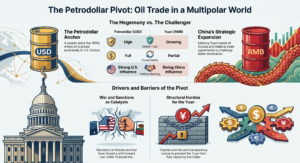
The Rise of the Yuan in Oil Markets
China, the world’s largest oil importer, is actively promoting the yuan as an alternative settlement currency.
Strategic Moves by China
- Yuan-based oil futures markets
- Bilateral trade agreements with oil exporters
- Expansion of cross-border payment systems
Countries like IRAN under economic pressure or sanctions increasingly find the
yuan a viable alternative.
| Feature | Petrodollar (USD) | Yuan (RMB) |
|---|---|---|
| Global Trust | High | Growing |
| Convertibility | Full | Partial |
| Political Backing | Strong U.S. influence | Rising China influence |
Challenges Facing the Yuan
- Capital controls in China
- Limited global convertibility
- Transparency concerns
These factors prevent the yuan from immediately replacing the dollar.
Future Outlook: A Multi
polar Cu
rrency World
The global economy is moving toward diversification rather than replacement.
Likely Scenario
- Continued dollar dominance
- Gradual yuan expansion
- Emergence of multi-currency trade systems
Conclusion
The “petrodollar vs yuan impact 2026” debate reflects a deeper transformation driven by war, sanctions, and strategic economic policies. While the U.S. dollar remains dominant, the yuan is steadily carving out space in global oil trade.
For digital publishers and investors alike, this topic represents a high-value, low-competition opportunity to capture emerging search traffic.
About The Author